Fraud & ID Theft Prevention
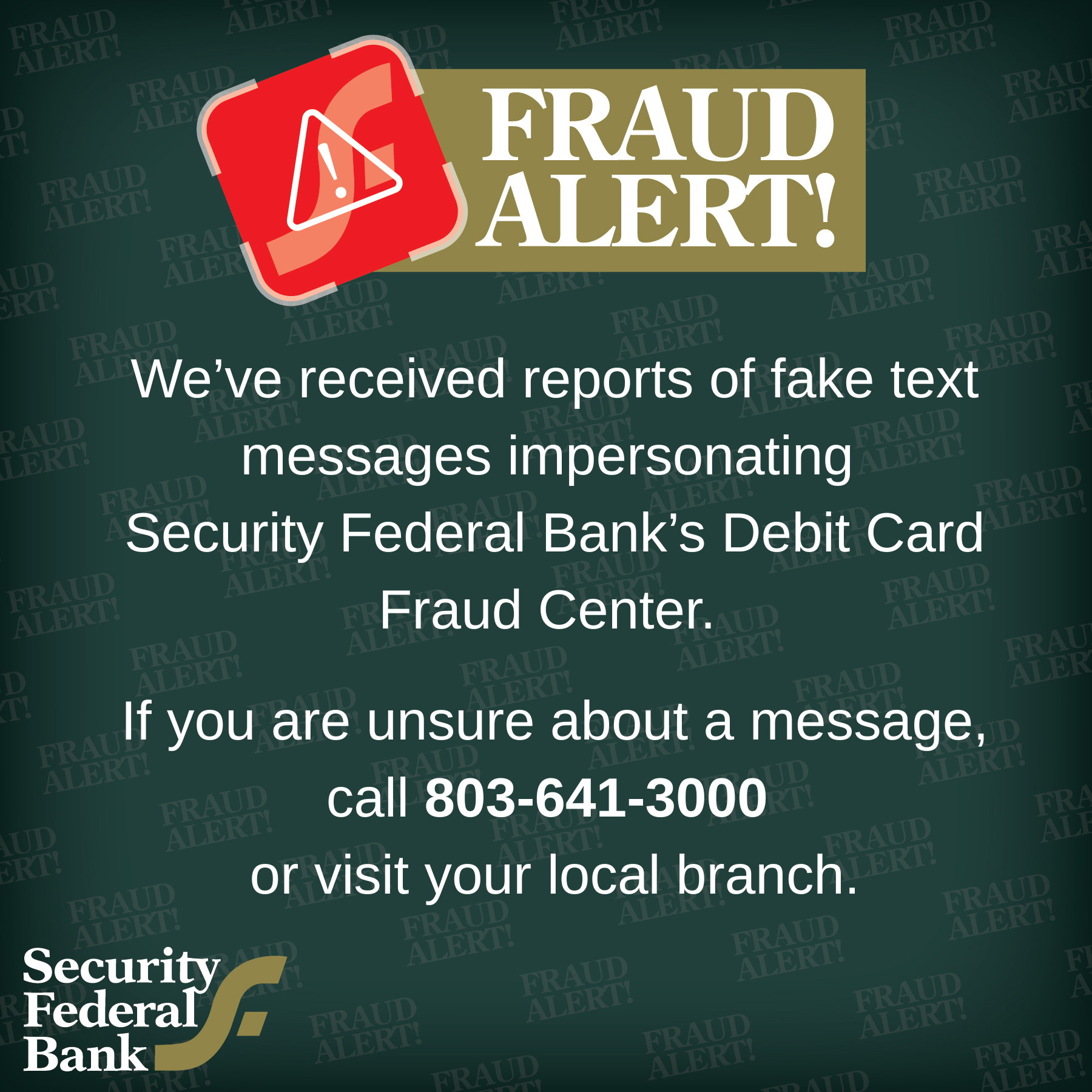.png)
Fraud Prevention Services
We have fraud prevention services which provide notification to alert you of possible fraudulent activity associated with your card.

SMS/Text Alerts

Email Notifications

Receive a Call
Here’s How It Works:
When potential fraud is detected, our system will attempt to reach you using the Customer Contact Sequence below, in this exact order:
-
Automatic SMS/Text Message
-
Automatic Email
-
Call to your Home Phone
-
Call to your Cell Phone
-
Call to your Work Phone
If you answer an automated call and indicate that you do not recognize the transaction, the system will immediately place you on hold and connect you with a live fraud analyst for assistance.
Remember, our messages will NEVER ask for your PIN or account number.
Alert Delivery Hours:
- SMS/Text & Email: Delivered 24/7
- Automated & Live Phone Calls: 8:00 AM – 9:00 PM EST, 7 days a week
Text Message Short Codes:
- 96923 – Used for all debit-card related fraud alerts
- 32874 – Used for full-service credit-card alerts
These short codes have remained consistent for an extended period, and there are no planned changes.
Text message “short codes” are special 5-digit phone numbers that companies use to send secure, automated messages. These numbers are shorter than regular phone numbers and are designed specifically for things like fraud alerts, account notifications, and verification codes.
Bank Initiated Hot-Carding:
Our fraud center quickly blocks a card to prevent further transactions after known fraud occurs.
Customer Initiated Hot Carding:
We also offer convenient methods for immediate customer deactivation of a card if it is lost or stolen. This action can be taken through Online Banking, our Mobile App, or iTalk.
Example of a Fraud Alert Text Message:
FreeMSG SFB Fraud Alert
We need to verify a transaction on card 0818:
$9.98 – HEARSTYLES DOT – 27 Oct
Reply NO FRAUD if this is yours or FRAUD if you don’t recognize it.
Case Ref# 150067
Txt STOP to OptOut
Tips to Prevent ID Theft
Identity theft involves the unlawful acquisition and use of someone’s identifying information, such as: Name, Address, Date of Birth, Social Security Number, Mother’s Maiden Name, Driver’s License, Bank Account Number or Credit Card Number.
How to Protect Yourself:
- Report lost or stolen checks, debit or credit cards immediately
- Never give our any personal information including birth date, SSN or passwords
- Shred all documents containing personal information, like bank statement, unused checks, deposit slips, credit card statements, pay stubs, medical billings and invoices.
- Don’t give any of your personal information to any websites that do not use encryption or other secure methods to protect it.
- Order a free copy of your credit report periodically to monitor your accounts
• Equifax or Call 1-800-685-1111 to order a report
• Trans Union or 1-800-916-8800 to order a report
• Experian or 1-888-397-3742 to order a report
What if my information is lost or stolen?
- Contact your financial institution immediately.
- Immediately change any passwords that might be compromised.
- Contact credit reporting companies and place a fraud alert on your credit file.
• Equifax or Call 1-800-525-6285 to report fraud
• Trans Union or Call 1-800-680-7289 to report fraud
• Experian or Call 1-888-397-3742 to report fraud - Consider reporting the attack to the police and file a report with the Federal Trade Commission
Tips to Reduce Fraudulent Transactions
- If it sounds too good to be true, it usually is.
- Nothing is free, not even “Free Trial” of products and services. Read the “fine” print.
- “Always” read the terms and conditions of products and / or services. This is where the true price will be revealed or state the charges at a later date.
How to Protect Yourself from Online Fraud
Online fraud continues to grow in sophistication and frequency. These scams appear in many forms but they are especially prevalent in emails and websites. Here are a few tips on protecting yourself online.
- First and foremost, be careful of what you click on links and attachments. They might contain malicious code or malware.
- Be careful of Pop-up advertisements. They might attempt to obtain sensitive information from you or harbor malicious links. Use web blocking and filtering applications or services. Many of them contain software that will help you determine if a website is safe or not.
- Do NOT use the same ID and Password for every online account you have. That way if one account is compromised, not all of them are.
- Change your password frequently and use complex passwords (numbers, letters, special characters).
- Do NOT store your ID and password information where others could gain access to it. It is best not to write the information down at all or share them with others. Use multifactor authentication.
- Be aware of Phishing attempts (websites or emails) that try to obtain personal or confidential information from you.
- Beware of public Wi-Fi connections and public computers because they could have malicious software installed on them that can collect your data. If possible, connect to the Internet using a VPN service.
- Make sure your software and Operating system is up-to-date with the latest security patches.
- Secure your PC with Antivirus, Firewall and Anti-Malware software.
- Connect to websites using a secure connection (HTTPS). This helps secure a connection to your favorite site and prevents eavesdropping into your connection with that site. You can type in HTTPS into your address bar to see if that service is available for your favorite service. i.e. HTTPS://google.com.
- Check your account balance regularly to detect irregularities
- Use your pin whenever the option is available
- Opt-in for transaction text alerts
- Use your mobile phone or other rapid means to immediately deactivate a card when required
- Set a PIN/Password on your phone and enable the “Find my Phone” option on your device so you can find your phone online or remotely erase your phone.
- Backup your data
- Never send sensitive information over email unless it’s encrypted
- Use multi-factor authentication when possible
Social Engineering/Phishing Attacks
In a social engineering attack, an attacker uses human interaction (social skills) to obtain or compromise information about an organization or its computer systems. An attacker may seem unassuming and respectable, possibly claiming to be a new employee, repair person, or researcher and even offering credentials to support that identity. However, by asking questions, he or she may be able to piece together enough information to infiltrate an organization's network. If an attacker is not able to gather enough information from one source, he or she may contact another source within the same organization and rely on the information from the first source to add to his or her credibility.
Sign up to receive the Security Federal Bank newsletters
* indicates required fields
Thank you for signing up!
Someone from our office will reach out to you soon, if necessary.